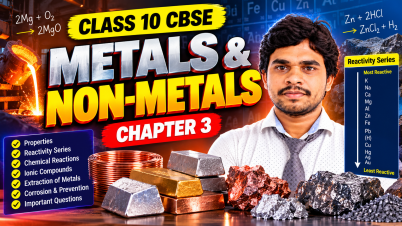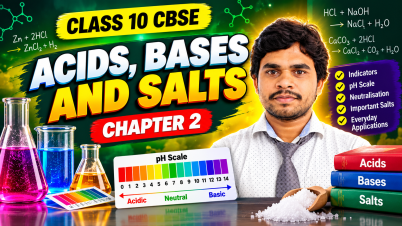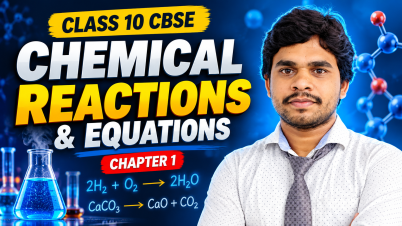
No items in cart
Master Carbon and Its Compounds from Class 10 CBSE Science with easy explanations of covalent bonding, versatile nature of carbon, saturated and unsaturated hydrocarbons, homologous series, functional groups, nomenclature, ethanol, ethanoic acid, esterification, combustion, oxidation, addition and substitution reactions, and soaps and detergents. Practise NCERT questions, chemical equations, MCQs, and important board-exam questions with StudyAmigos.
Welcome to Carbon and Its Compounds, an important chapter in Class 10 CBSE Science. This course introduces students to the fascinating chemistry of carbon, the element that forms the foundation of countless substances found in living organisms and everyday materials.
Students will learn why carbon forms a vast number of compounds, how covalent bonds are formed, how organic compounds are classified and named, and how important carbon compounds such as ethanol and ethanoic acid behave chemically.
The course also explores soaps and detergents, helping students connect chemistry concepts with everyday life. Through clear explanations, structural formulae, balanced chemical equations, examples, and examination-oriented practice, students will build a strong foundation in organic chemistry.
By the end of this course, students will be able to:
Explain the versatile nature of carbon.
Understand covalent bonding and electron sharing.
Draw electron-dot structures of simple covalent compounds.
Explain tetravalency and catenation.
Differentiate between saturated and unsaturated hydrocarbons.
Identify alkanes, alkenes, and alkynes.
Understand straight-chain, branched-chain, and cyclic carbon compounds.
Identify homologous series and their characteristics.
Recognise common functional groups.
Learn the basic nomenclature of carbon compounds.
Understand combustion, oxidation, addition, and substitution reactions.
Explain the properties and reactions of ethanol and ethanoic acid.
Understand esterification and saponification.
Explain how soaps and detergents work.
Solve NCERT exercises, MCQs, and important CBSE examination questions.
Introduction to carbon and its importance
Carbon in living organisms and everyday materials
Covalent bonding
Electron-dot structures of methane, ethane, and other simple compounds
Tetravalency of carbon
Catenation and its significance
Why carbon forms a large number of compounds
Formation of single, double, and triple covalent bonds
Sharing of electrons between atoms
Structural representation of carbon compounds
Hydrocarbons
Saturated and unsaturated carbon compounds
Straight-chain, branched-chain, and cyclic structures
Important structural formulae and examples
Meaning of a homologous series
Characteristics of homologous series
Difference between successive members
Alkanes, alkenes, and alkynes
Common functional groups
Basic rules for naming carbon compounds
Introduction to alcohols, aldehydes, ketones, and carboxylic acids
Important structures and nomenclature practice
Combustion reactions
Complete and incomplete combustion
Oxidation reactions
Addition reactions of unsaturated hydrocarbons
Hydrogenation and its applications
Substitution reactions of saturated hydrocarbons
Important balanced chemical equations
Practical examples from everyday life
Ethanol (C₂H₅OH)
Structure and properties of ethanol
Reactions of ethanol with sodium
Oxidation of ethanol
Dehydration of ethanol
Important chemical equations and applications
Ethanoic Acid (CH₃COOH)
Structure and properties of ethanoic acid
Acidity and reactions with carbonates and hydrogen carbonates
Reaction with bases
Reaction with alcohols
Esterification
Uses of ethanoic acid
Important observations and balanced equations
Introduction to soaps and detergents
Structure of a soap molecule
Hydrophilic and hydrophobic parts
Cleansing action of soap
Formation of micelles
Difference between soaps and detergents
Soap in hard water
Advantages and limitations of soaps and detergents
Everyday applications
Important NCERT in-text questions
NCERT exercise solutions
Important chemical equations
Electron-dot structure practice
Structural formula and nomenclature questions
Multiple-choice questions (MCQs)
Assertion–reason questions
Competency-based questions
Case-based questions
Important short-answer and long-answer questions
Quick revision notes and chapter summary
This course is ideal for:
Class 10 CBSE students studying Science.
Students preparing for school examinations and CBSE board examinations.
Learners who want to understand the fundamentals of organic chemistry.
Students who find covalent bonding, structural formulae, and nomenclature difficult.
Students who want to practise chemical reactions and NCERT-based questions.
The course follows a simple, systematic, and student-friendly approach. Each concept is explained using structural formulae, electron-dot diagrams, balanced chemical equations, and practical examples.
Special attention is given to understanding carbon bonding, identifying different types of hydrocarbons, learning nomenclature, and predicting the chemical reactions of ethanol and ethanoic acid.
Concept-based explanations and practice questions help students develop confidence in answering both direct and application-oriented examination questions.
After completing this course, students will be able to:
Understand the unique bonding properties of carbon.
Draw and interpret simple structural formulae.
Differentiate between saturated and unsaturated hydrocarbons.
Identify homologous series and common functional groups.
Write important chemical equations involving carbon compounds.
Explain the properties and reactions of ethanol and ethanoic acid.
Understand the cleansing action of soaps and detergents.
Prepare effectively for NCERT exercises and CBSE examinations.
Subject: Chemistry / CBSE Science
Class: 10
Board: CBSE
Chapter: 4 – Carbon and Its Compounds
Course Level: Beginner
Course Duration: Approximately 4 hours
Language: English
Instructor: Krishna Adari
Platform: StudyAmigos
Build a strong foundation in organic chemistry with this comprehensive course on Carbon and Its Compounds. Learn covalent bonding, explore hydrocarbons, understand important chemical reactions, and discover the science behind soaps and detergents.
Join StudyAmigos and prepare confidently for your Class 10 CBSE Science examinations.

Chemistry Faculty

Lorem Ipsum is not the simply random text